


The Russian occupation army is testing an updated tactic in the Siversky and Sloviansk–Lyman directions, attempting to create conditions for further advancement toward the Ukrainian fortification line from the northeast and east. This involves a new operational approach that combines a prolonged campaign of aerial battlefield denial, tactical actions to isolate certain areas, infiltration missions, and massive attacks by small groups.
Source: OBOZREVATEL
This is reported in a new assessment by the Institute for the Study of War (ISW). Earlier, analysts observed the use of a similar scheme in the Pokrovsk, Velykomykhailivka, and Hulyaipole directions.
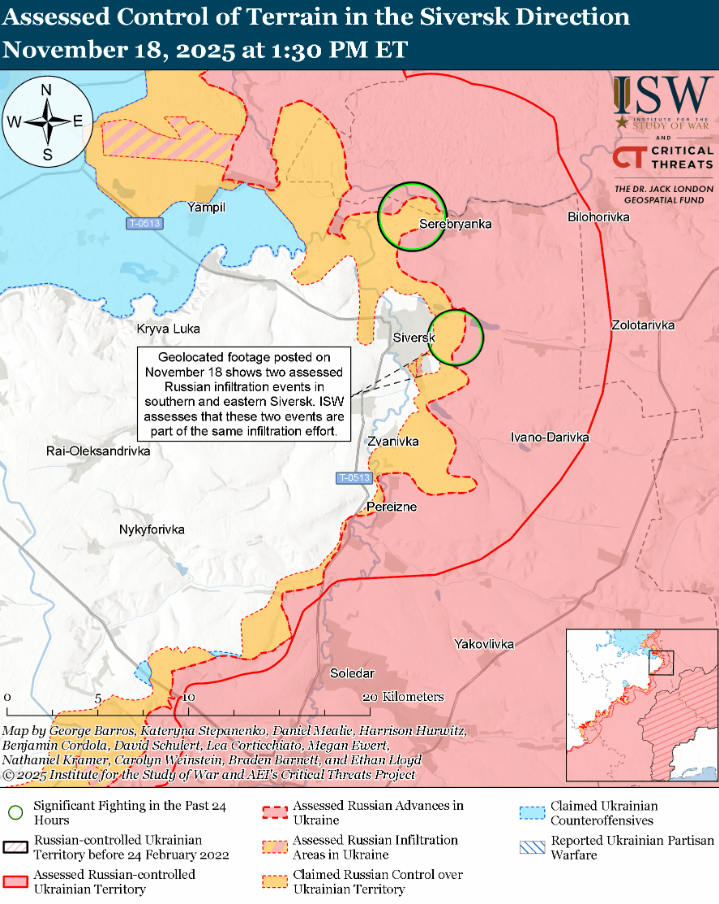
The occupiers achieve success near Siversk


According to geolocated data published on November 18, Russian units recently advanced south and east of Siversk. One Russian milblogger suggested that this advance may indicate an intention to discreetly accumulate forces in the city, as was the case in Pokrovsk.
On the same day, the Russian Ministry of Defense claimed that units of the 7th Motorized Rifle Brigade (3rd Army Corps) had allegedly taken control of Platonivka, located northwest of Siversk. According to Russia’s MoD, the capture was facilitated by a diversion maneuver and an advance under the cover of fog and rain, when Ukrainian units had limited drone capabilities, as well as strikes by FPV drones and artillery.
The Russian MoD also stated that taking control of Platonivka would make it possible to block the T-0513 Lyman–Siversk road. However, ISW has not recorded geolocated evidence confirming this alleged advance. According to a source connected to Ukrainian military intelligence, as of November 17 Ukrainian units had not allowed Russian forces to reach this road.
The enemy is waiting for the freeze
Ukrainian military sources reported that Russian units have recently conducted infiltration movements by small groups to gradually accumulate forces in the Siversky direction. It is also expected that after the ground freezes in winter, the Russian army may shift to larger mechanized offensive operations. In addition, Russian forces have been simultaneously striking forward Ukrainian positions with various types of drones, attempting to complicate the logistics and supply of the Ukrainian Armed Forces.
“Russian forces are similarly using infiltration tactics in the Sloviansk–Lyman direction amid poor weather conditions and ongoing efforts to disrupt Ukraine’s ground lines of communication (GLOCs) in the area. The spokesperson for Ukraine’s 3rd Army Corps reported on November 18 that Russian forces are attempting to infiltrate and occupy forward positions in the Lyman direction to create conditions for future flanking attacks and to draw Ukrainian forces into a semi-encirclement,” the report says.
The spokesperson stated that Russians conduct infiltration operations during rain and fog, as such conditions make it more difficult for Ukraine to use drones. He also noted that occupation forces are attempting to weaken Ukrainian logistics through tactical drone strikes and infiltration actions aimed at accumulating forces for future larger offensives.
Russia attempts to disrupt Ukrainian supply lines
A sergeant of one of the Ukrainian brigades operating in the Lyman direction confirmed on November 18 that Russian forces are attempting to prepare conditions for an offensive in the unit’s area of responsibility to disrupt Ukrainian supply lines.
Earlier, ISW noted that Russian forces achieved initial successes in Pokrovsk and surrounding areas after partially implementing aerial battlefield denial. This reduced the situational awareness of Ukrainian units and created opportunities for Russian infiltration.
Additionally, in the Pokrovsk direction, Russian forces actively used unfavorable weather to bypass Ukraine’s “drone wall” and penetrate weak points in the defense. They attempted to apply a similar tactic in the Velykomykhailivka and Hulyaipole directions.
“Russian forces appear to be using this campaign plan in the Siversk and Sloviansk–Lyman directions to put pressure on the Fortress Belt — Ukraine’s main defensive line in Donetsk Oblast. Russian forces will likely continue infiltration in Siversk and may attempt to infiltrate in Lyman, but they will likely have to commit significant manpower, equipment, and time to replicate their successes in Pokrovsk,” the report states.
Russian units face difficulties in consistently applying this offensive approach in the Pokrovsk direction. This indicates broader challenges they are likely to encounter while attempting to implement such a campaign plan across the entire frontline.




Discussion about this post