
The majority of Ukrainian citizens do not support the “peace plan” that involves concessions to Russia, including the withdrawal of Ukrainian troops from Donbas, reduction of the army, and lack of clear security guarantees.
Source: Bukvy
This is evidenced by the data from a sociological survey conducted by the Kyiv International Institute of Sociology (KMIS) from November 26 to December 13.
According to the study, three-quarters of respondents called the plan proposed by Russia “completely unacceptable.” The share of those willing to agree with such an approach remains unchanged compared to the previous survey, at 17%.
At the same time, another settlement model — a joint plan of Ukraine and European partners — is supported by the majority of respondents. Sociologists note that 72% of Ukrainians are inclined to agree with this option, although often without much optimism. Fourteen percent of respondents are categorically against it.
KMIS explained that during the survey, two shortened versions of possible “peace plans” were used. One described a scenario developed by Ukraine together with Europe, and the other reflected Russia’s position. Each participant was randomly read only one of these scenarios, without specifying who had proposed it.
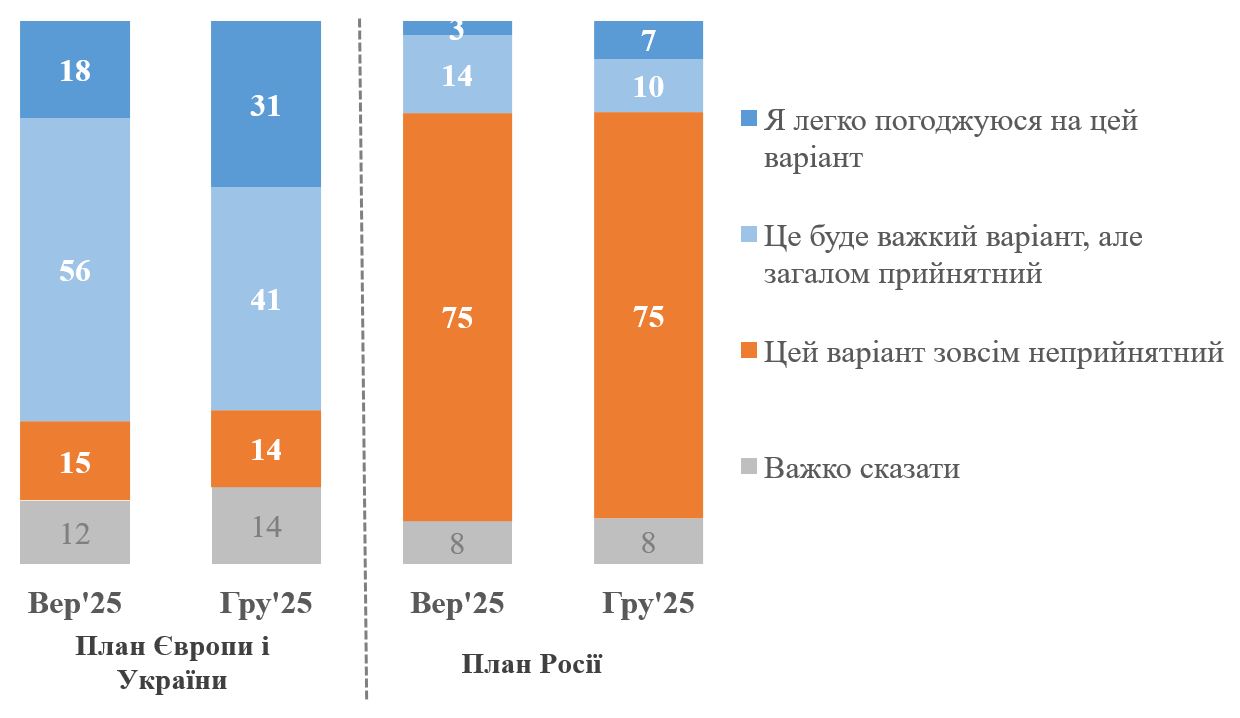

Photo: KMIS
Conditional plan of Europe and Ukraine:
Ukraine receives reliable security guarantees from Europe and the United States, which include sustainable supplies of weapons and funds to Ukraine in sufficient amounts, as well as the closure of Ukrainian airspace to Russian attacks;
the current front line is frozen, Russia retains control over the occupied territories, but Ukraine and the world do not officially recognize this;
Ukraine moves toward accession to the EU;
sanctions against Russia remain in place until a sustainable peace is established and the threats of a renewed attack by Russia disappear.
Conditional plan of Russia:
the United States and Europe lift all sanctions against Russia;
the Russian language receives official status;
Ukraine must significantly reduce its army and limit its armaments;
Ukraine permanently renounces NATO membership, and the West can no longer supply weapons to Ukraine;
Russia has the right to determine what security guarantees for Ukraine will be and will be one of the guarantor countries of Ukraine’s security;
Ukraine withdraws its troops from part of Donetsk region that it currently controls, that is, from Kramatorsk, Sloviansk, and other cities;
Ukraine officially recognizes Crimea, Donetsk, and Luhansk regions as part of Russia and permanently renounces them;
Russia retains control over the occupied parts of Kherson and Zaporizhzhia regions.
At the same time, 63% of Ukrainians are ready to endure the war for as long as necessary. This indicator has hardly changed compared to September. Another 1% of respondents said they could endure it for about a year.
The share of those who name shorter timeframes — several months or up to six months — is 15%. Sociologists note that this indicator has decreased compared to the September survey; however, the number of respondents who were unable to decide on an answer has increased significantly.
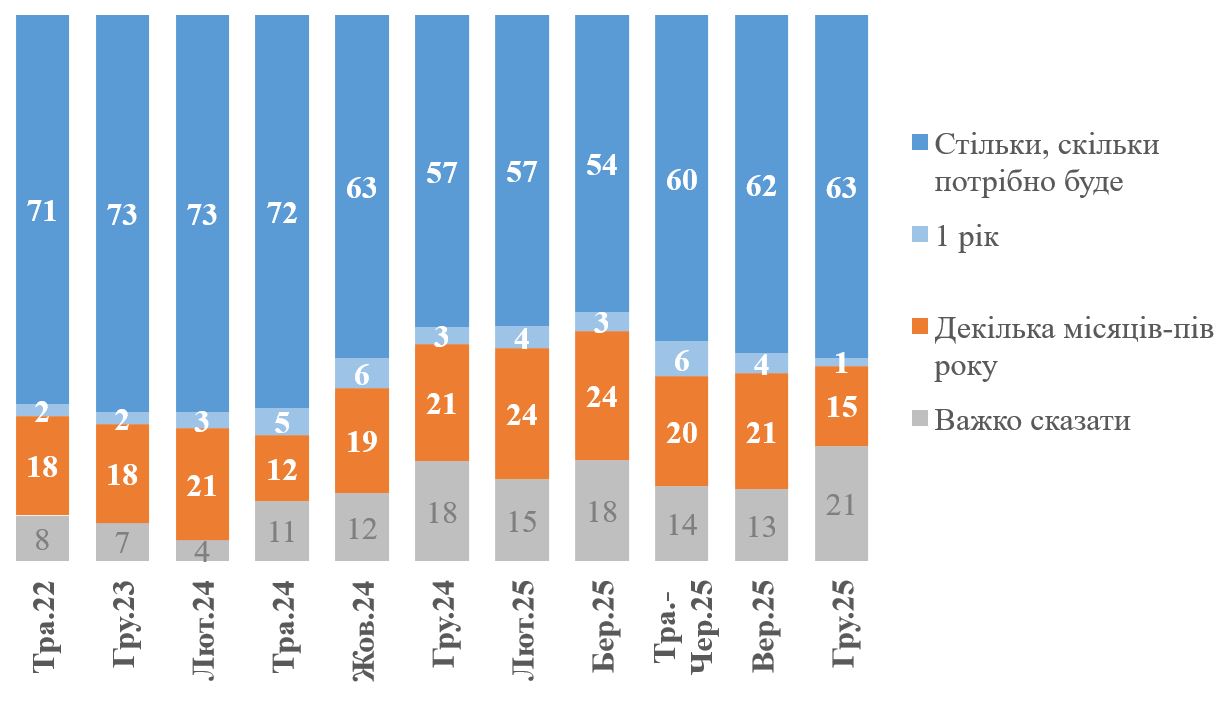

Photo: KMIS
The study also separately analyzed expectations regarding possible timelines for the end of the war. Only 9% of Ukrainians consider its end before the beginning of 2026 to be likely, which is almost half as many as in the previous survey.
Another 14% of respondents expect the end of hostilities in the first half of 2026, and 11% in the second half of the same year. The largest share of respondents — 32% — believe that the war will last until 2027 or longer.
Sociologists also point to growing uncertainty in society: one third of respondents — 33% — were unable to give a clear answer regarding possible timelines for the end of the war. Compared to September, the share of such responses has increased significantly.
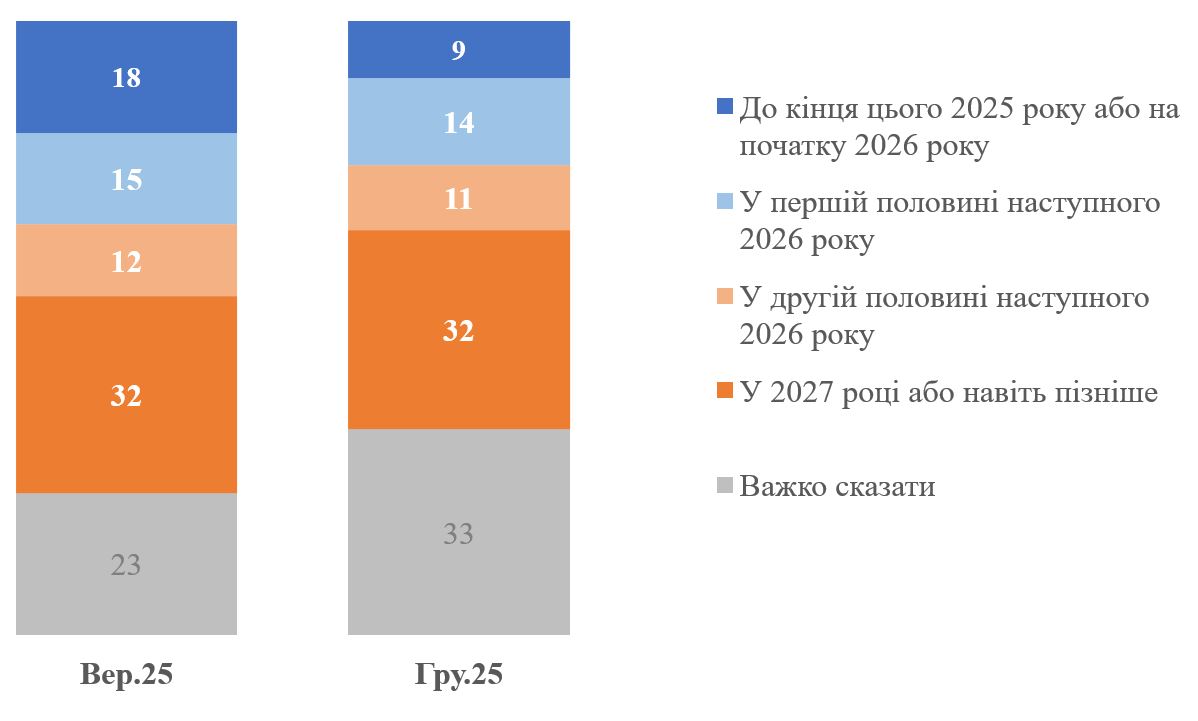

Фото: КМІС
The study was conducted from November 26 to December 13. Using telephone interviews based on a random sample of mobile numbers, 547 respondents aged 18 and older, living in territories of Ukraine controlled by the Ukrainian government, were surveyed.