



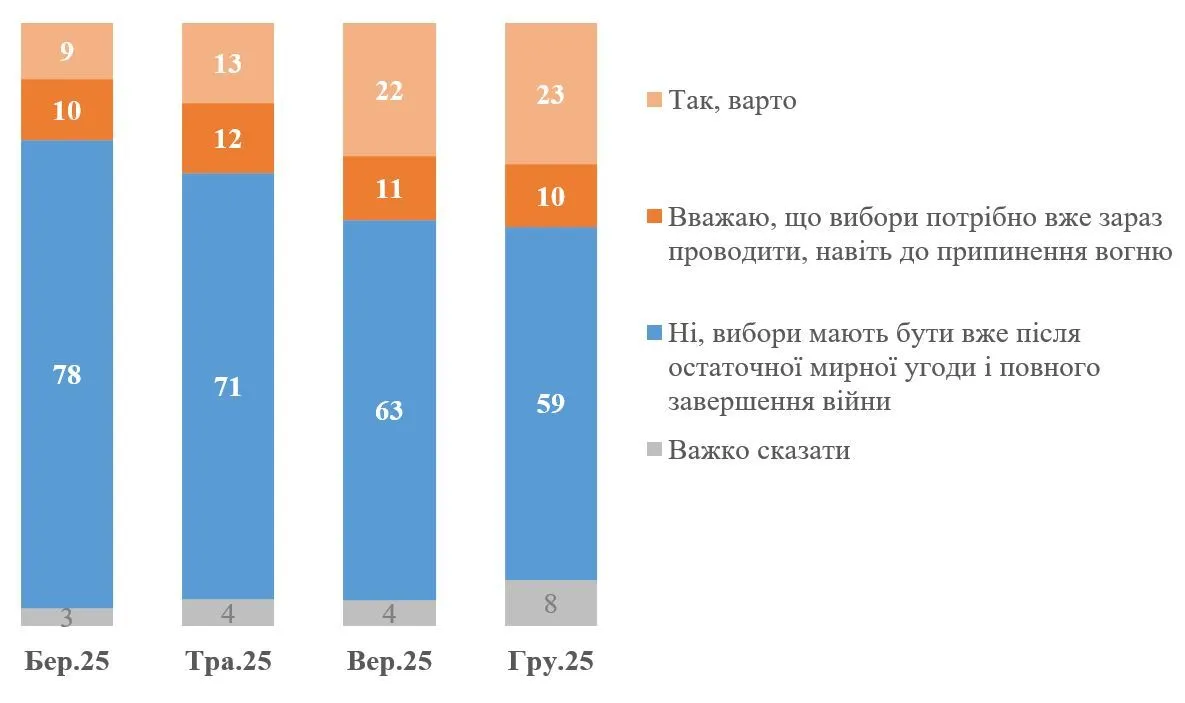
Only one in ten Ukrainians believes that elections in Ukraine should be held before a ceasefire and the receipt of security guarantees. If these two conditions are ensured, the number of supporters of holding elections more than doubles, to 23%.
Source: OBOZREVATEL
At the same time, the demand for holding elections strongly depends on how much the respondent trusts the current President of Ukraine, Volodymyr Zelenskyy, and whether they see signs of the formation of authoritarianism in present-day Ukraine. This is evidenced by the results of a survey conducted by the Kyiv International Institute of Sociology.
Do Ukrainians support holding elections before the end of the war


According to the KMIS survey results, only 10% of Ukrainians believe that elections should be held before a ceasefire. In September 2025, when sociologists studied public sentiment regarding this possibility, 11% supported the idea of holding elections before the establishment of calm.
The number of supporters of holding elections more than doubles provided that a ceasefire and reliable security guarantees for Ukraine are achieved: under such circumstances, 23% would support elections. Sociologists note that a growth trend is recorded here, as back in March only 9% of respondents supported this option.
However, the majority of Ukrainian citizens — 59% (63% in September) — continue to insist that holding elections is possible exclusively after reaching a final peace agreement and the complete end of the war.
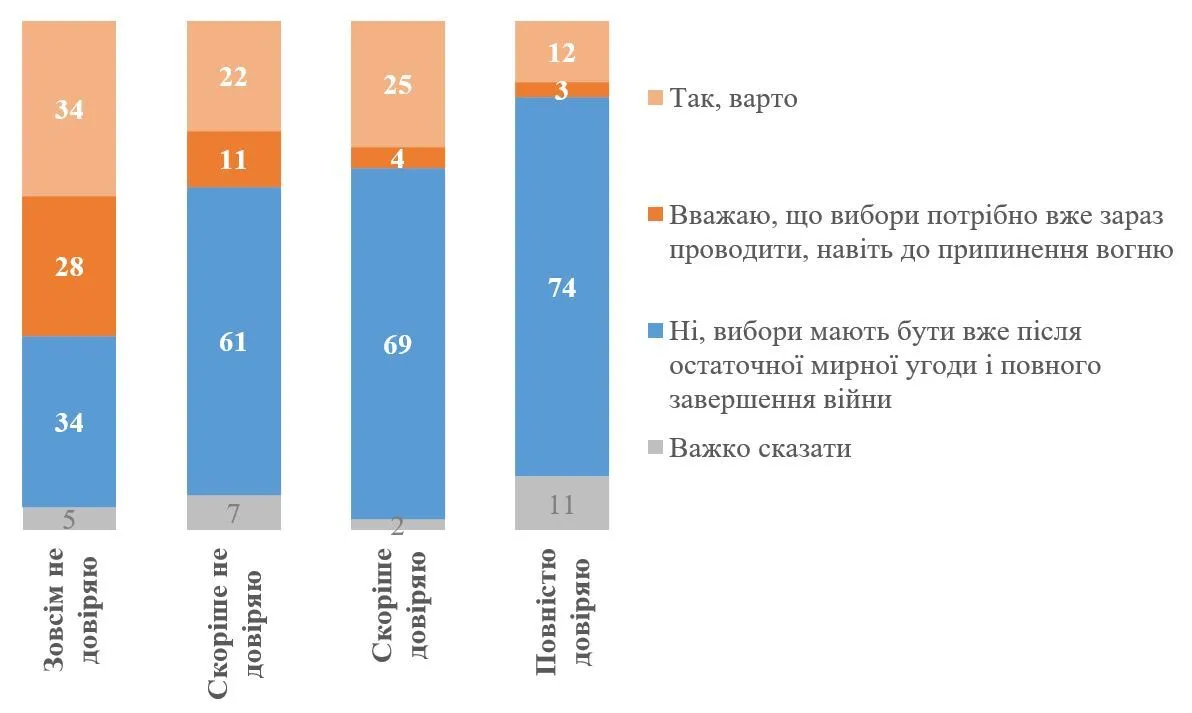
Support or opposition to holding elections correlates with whether the respondent trusts the current head of state. The majority of those who trust Zelenskyy support holding elections only after a final peace agreement. Only up to 4% of them favor elections even before the end of hostilities.
Among those who lack trust in the president, there is a certain “split.” The majority of respondents who “mostly do not trust” Zelenskyy believe that elections are possible only after a peace agreement: as of December 2025, this was about 61%, and only 11% want to elect a new central government before the end of hostilities. If a stable ceasefire and security guarantees are first ensured, the number of supporters for holding elections before peace rises to 22%.
Among those who do not trust Zelenskyy at all, 28% insist on holding elections in the near future, 34% consider them appropriate after a ceasefire with security guarantees. By the way, those who do not trust the president and do not want elections before the end of the war also make up 34%.
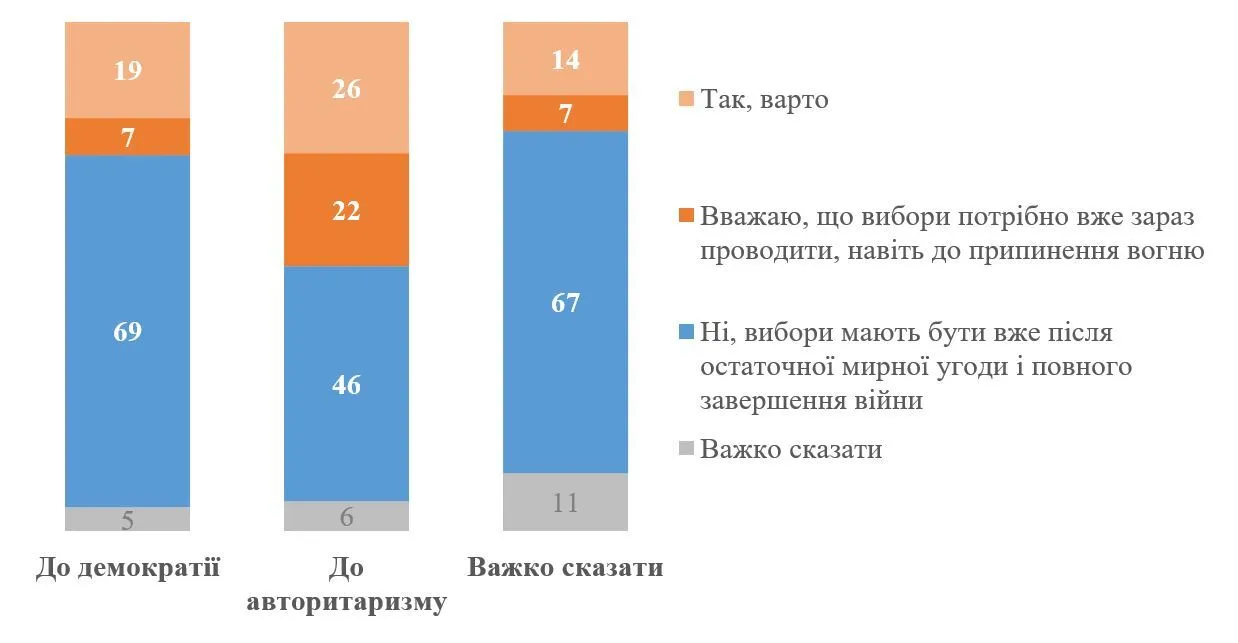
Sociologists also note that among Ukrainians who believe the state is currently moving toward authoritarianism, there is an increased demand for holding elections. However, even in this category, 46% postpone the electoral process until a final peace agreement, and only 22% support holding elections as soon as possible.
What about trust in President Zelenskyy?
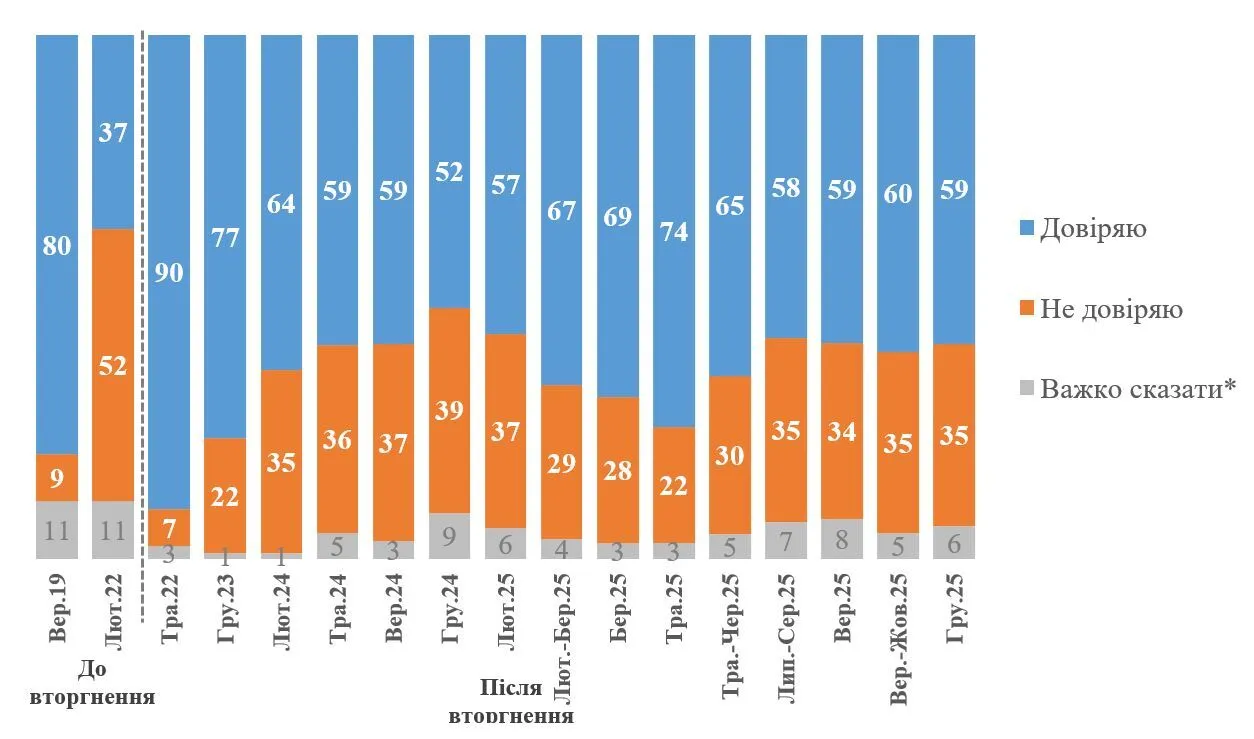
KMIS states that despite all difficulties, internal problems, and scandals, the current president maintains a positive trust balance. In December, 59% of Ukrainian citizens trusted him, while 35% did not (the trust/distrust balance is +24%).
These results are very close to those in October: at that time, the survey was conducted before the corruption scandal in the energy sector uncovered during “Operation Midas,” which involved top officials and people close to Zelenskyy.
At the same time, sociologists emphasized the dynamic nature of trust indicators in the president and their strong dependence on the political context — from internal corruption scandals or the work of state institutions to relations with partners and “peace negotiations.”
For example, after the “Operation Midas” scandal, which became known on November 10, trust in Zelenskyy was 49% (the survey was conducted in the last days of November).
In the first half of December, there was a surge in trust — up to 63%; sociologists explain this by the “rallying around the flag” amid the international situation and the “negotiation track.”
However, in the second half of December, the number of Ukrainians who trust Zelenskyy decreased to 55%.
“In any case, by the end of 2025, the level of trust in the president is higher than at the end of 2024 (although during 2025, peak support was at the beginning of May). It can be expected that even now (for example, considering personnel changes), the trust indicator for the president will remain dynamic,” KMIS notes.
Sociologists also pointed out that among the 59% of Ukrainians who trust Zelenskyy, 26% trust him “completely,” and another 33% “mostly trust” him. It is precisely those who chose “complete trust” who would like to see the current president remain in the highest office after the elections. Those who “mostly trust” him prefer that the presidential seat changes hands as a result of the elections.
Regarding the 35% of Ukrainians who expressed distrust in Zelenskyy, 23% do not trust him at all, and 12% “mostly do not trust” him.

Discussion about this post